Why We Build Hometown Directories Instead of Chasing National Platforms
2026-04-14
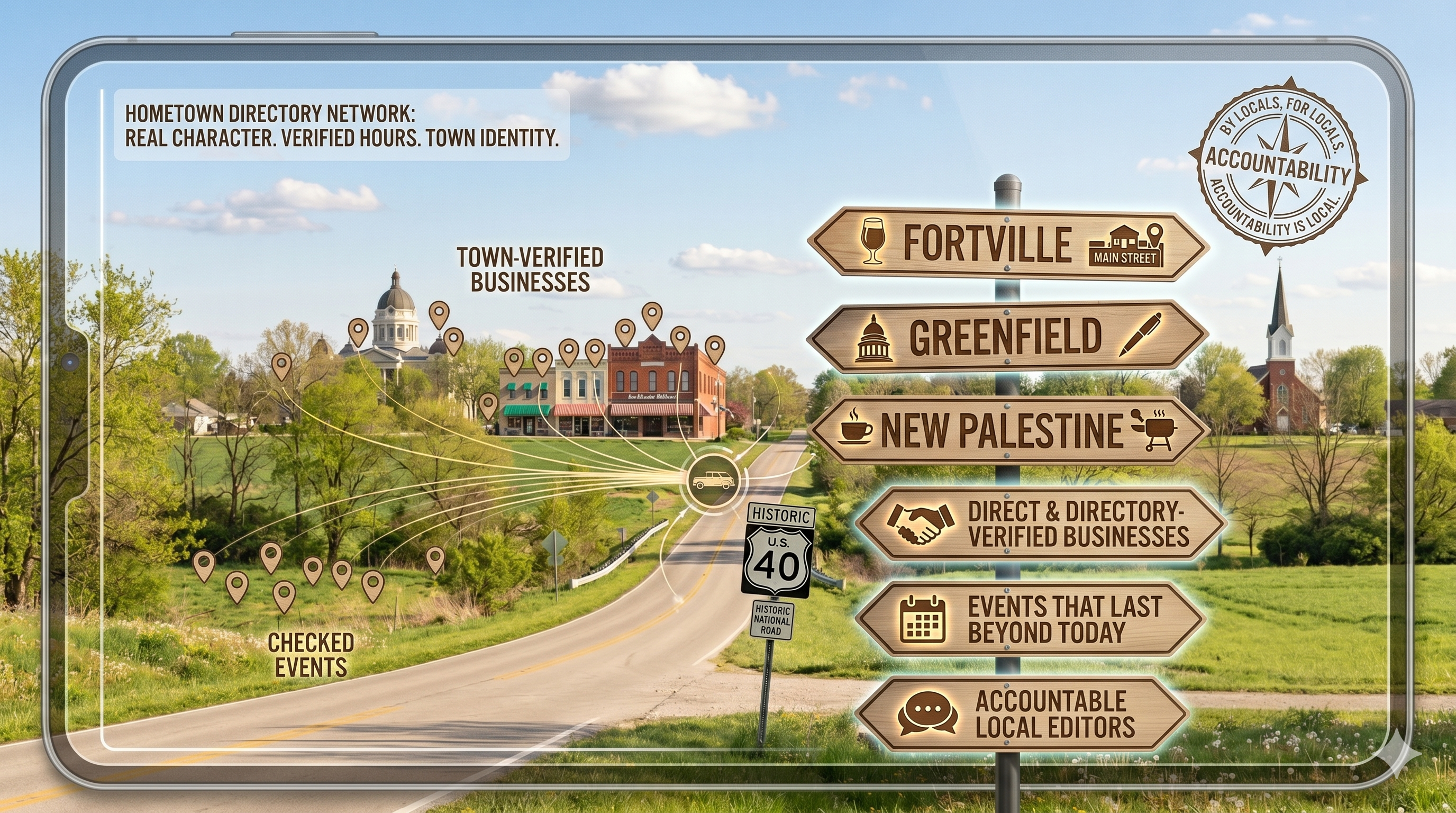
Every town already has a dozen ways to be found online. Google Maps lists every business. Yelp ranks them. Big-city tourism bureaus cover the metropolitan tourist beat. Facebook groups handle events. So why build a set of small, local directory sites for individual Indiana towns?
A few reasons.
National platforms don’t know your town
Open Google Maps in Fortville, Indiana. Type “restaurants.” You’ll get an algorithmic sort that doesn’t understand which place has been around since 1976, which chef just won a regional award, which place the kids’ baseball team walks to after games. It’ll show you a chain pizza before it shows you Taxman.
That’s not Google’s fault — it’s their model. National platforms optimize for scale. They serve every town the same way, with the same ranking signals. The result is that every small town looks roughly the same on the internet, even when they aren’t.
Yelp is a popularity contest
Yelp reviews have real value — but they’re heavily weighted toward the loudest customers, not the most accurate ones. A small-town institution with 40 years of loyal families shows up with fewer reviews than a new chain location that opened six months ago and incentivized early reviews. A contractor who did great work for a quiet retired couple shows up behind one with a bigger social-media presence.
Big-city tourism bureaus have a different beat
Big-city tourism bureaus do their job well — promoting Indianapolis to travelers at scale. But the restaurants, shops, and events in Fortville, Greenfield, or New Palestine aren’t on their beat, and shouldn’t be. Small towns need their own surface.
Facebook groups are temporary
Community Facebook groups are a genuinely great local resource — but they’re chronological, closed, and built on Facebook’s timeline. An event posted today is invisible a week later. Information doesn’t compound.
What a local directory does differently
When a directory is built by someone who actually lives in the town:
- Listings reflect real character. The 40-year-old ice cream shop gets the write-up it deserves. The new place that’s actually good gets a fair shot.
- Events stay findable. Published once, searchable for weeks after. Annual events show up next year too.
- Businesses get context, not just a pin. Who owns it, how long they’ve been there, what they’re known for, when they opened.
- Information gets checked. Every listing in our network is verified by someone who cares whether the hours are right.
The network, not the platform
Indiana Town Guide is intentionally structured as a network of independent town guides, not a single super-site. New Palestine Guide, Fortville Guide, Indy Event Guide, Greenfield Town Guide (coming) — each one is its own site, its own URL, its own editor.
Why?
- Local focus compounds. The Fortville guide can go deep on Main Street because it isn’t trying to also cover Muncie. The New Pal guide can be obsessed with Dragons football because it isn’t also covering the Colts.
- Town identity stays intact. A “central Indiana directory” flattens every town into a category. An individual town guide treats Fortville like Fortville, not like a subset of “Hancock County restaurants.”
- Accountability is local. If something’s wrong in a listing, the editor fixing it actually lives nearby and can verify firsthand.
- Communities can participate. Business owners can claim their listings. Residents can flag events. Town chambers of commerce have a partner, not a platform to fight.
The Indiana Town Guide hub (this site) exists to make the network findable — if you’re looking across towns, this is the front door. But the guides themselves are the real work.
Who we serve
There are three audiences for every town guide:
- Residents — the people who live in the town and want a cleaner way to find local businesses, events, and community resources than scrolling Facebook.
- Visitors — the people from the next county over, or from Indianapolis, who’ve heard something’s worth the drive.
- Business owners — the small businesses that can’t afford the SEO budgets to compete against national chains on Google, but deserve to be found by their own neighbors.
If we do this right, all three benefit. The resident finds what they’re looking for. The visitor drives in instead of driving past. The small business gets listed fairly, without paying to play.
What’s next
We’re covering Hancock County and Indianapolis tourism well. Next up: Greenfield Town Guide. After that: McCordsville, then the Cumberland / Eastern Hancock communities. Eventually, other Indiana counties.
The goal isn’t to cover every town in Indiana — it’s to cover each town we build for with the depth it deserves.
If you run a business, organize an event, or live in one of these towns and want to get involved, get in touch. We’d rather have a small network built well than a big network built fast.