The Pink Elephant and Other Roadside Icons of Indiana
2026-04-14 · Updated 2026-04-14
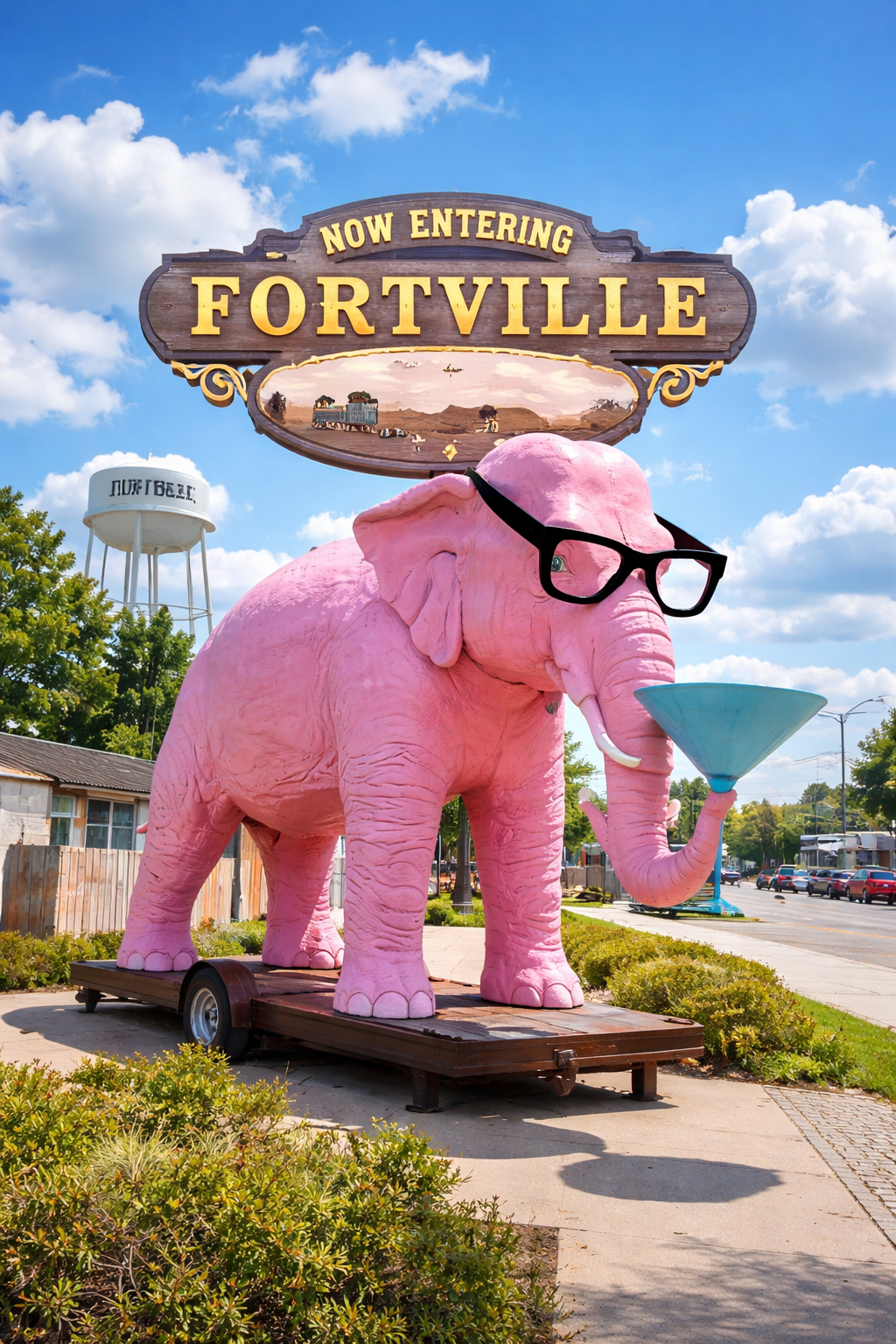
If you’ve driven through Fortville on Broadway Street, you’ve seen him. Twelve feet tall, nineteen feet wide — roughly the size of a real elephant — pink, wearing black-rimmed reading glasses, holding an enormous martini glass in his trunk.
His name is Ellatini, and he’s been part of Fortville for more than 40 years.
The real story
Ellatini sits at 308 W. Broadway Street, Fortville, in front of Elite Beverages (formerly Wagon Wheel Liquors). He was brought to Fortville in 1980 by Paul and Betty Dyer, the owners of Wagon Wheel Liquors at the time.
The Dyers first spotted the statue in Lawrence, Indiana, in front of the Cohron RV Park — where he was taking up temporary residence while Cohron’s iconic oversized cow statue was being repainted. They thought a pink elephant holding a martini would make a pretty good sign for a liquor store, rented him from Cohron for three months as a trial, and within months decided to buy him outright.
He’s been in Fortville ever since.
Why a pink elephant?
The image of a pink elephant is an old cultural shorthand for hallucinations brought on by drinking too much. The phrase “seeing pink elephants” traces back to the early 1900s. In mid-20th-century America, oversized pink elephant statues started appearing in front of liquor stores, taverns, and roadside bars across the country — folksy, funny, and unambiguous about what was sold inside.
Most of those original statues are gone now — torn down, sold, or left to weather away. Fortville’s elephant is one of the survivors.
The glasses
Ellatini came with his signature black-rimmed reading glasses — an odd but charming detail that makes him look like a slightly tipsy professor. At some point over the years, some local kids decided the glasses would make a great trophy and took them. Paul Dyer didn’t let it slide; he made a new pair. Those are the glasses you see today.
Why “Ellatini”?
For decades, he was just “the Pink Elephant.” A few years ago, the Fortville community formally gave him a name: Ellatini — a mashup of “elephant” and “martini.” It’s the kind of small-town personality touch that makes a roadside statue feel less like a gimmick and more like a neighbor.
What Ellatini means to the region
Ellatini has been featured in Atlas Obscura, Roadside America, and Visit Indiana. Travelers from across the country detour off I-69 specifically to see him. For locals, he’s more than a photo op — he’s a fixed point, a landmark people use to give directions, and the mascot behind the town’s annual Pink Elephant Days festival.
For the full deep-dive into the statue’s history and how Fortville adopted him, read Fortville Guide’s story: The Pink Elephant of Fortville — The Story Behind Ellatini.
How to visit
- Location: 308 W. Broadway Street, Fortville, IN 46040
- In front of: Elite Beverages
- Cost: Free — stop, take the selfie, buy a six-pack if you want
- When: Visible from the street anytime
From downtown Indianapolis, it’s about 30 minutes via I-69 and SR-238.
Indiana’s broader roadside-icon tradition
Ellatini isn’t alone. Indiana has a longer and deeper tradition of roadside attractions than most people realize:
- The World’s Largest Ball of Paint in Alexandria, IN (Madison County) — started by Mike Carmichael in 1977 as a baseball, now covered in thousands of coats of paint.
- Cohron’s giant cow statue (Lawrence, IN) — the same property where Ellatini temporarily stayed in 1980 before relocating to Fortville.
- Giant pigs, corn ears, and water-tower murals scattered across farm-country Indiana — visible proof that you are, in fact, somewhere.
The tradition comes from the Historic National Road era. When U.S. 40 was the main east-west route across the Midwest — before interstates — towns competed for travelers’ attention. Giant signs, roadside animals, and oddity-themed attractions were how a small town stayed visible. Even after the interstates bypassed most of those towns, the icons stayed.
What makes a roadside icon last
A few of these get bulldozed every decade — a business closes, a property changes hands, a town prioritizes something else. The ones that last share a few traits:
- Community adoption. The icon becomes part of the town’s identity, not just one family’s property. Ellatini belongs to Fortville now, not just to Elite Beverages.
- Access. People can easily pull over for a photo without interfering with a business.
- A name. “Ellatini” is memorable. “The sculpture on Broadway” isn’t.
- Ongoing care. When the glasses got stolen, Paul Dyer made new ones. That kind of stewardship is why Ellatini still looks sharp 40+ years later.
Ellatini has all four. That’s why he’s still there decades later, and why he keeps showing up on Fortville t-shirts, Christmas ornaments, and the branding for an entire community festival.
Other Hancock County landmarks worth knowing
The Pink Elephant isn’t Hancock’s only landmark:
- The James Whitcomb Riley Home in Greenfield — preserved boyhood home of the “Hoosier Poet,” open as a museum
- The Historic National Road (U.S. 40) — still visible in the downtown alignments of Greenfield and Cumberland
- Landmark Park in Fortville — modern, but the name fits
For more on Fortville and the Main Street restaurants, shops, and events near Ellatini, visit Fortville Guide.